
First Industrial Revolution: from farming to manufacturing
Everything you call a factory today was born between 1760 and 1840. And steam didn't create it. A decision did — one you have in front of you again.
Between 1760 and 1840 the economy stopped being farming and craft and became industrial. It started in Great Britain. From there it went everywhere.
Sebastian J. Brau's blog
Enter your email and you will get an alert when something new is published. Unsubscribe anytime.
The engine was the steam machine. For the first time, energy didn't depend on muscle, or on an animal, or on whether a river had water that month. And that allowed something that hadn't existed before: putting production inside a building.
That building is your factory. That's where it was born.
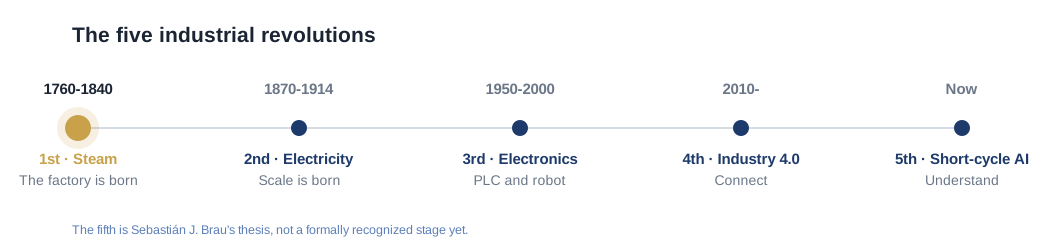
What actually changed
Before, producing was a scattered trade. The craftsman worked at home, at his own pace, with his own tools, and he decided whether the piece was good enough.
After, producing was something else: a lot of people, in one place, with machines that weren't theirs, at a pace somebody else set.
And pay attention here, because this is the part that matters: that change wasn't technical. It was organizational. With the factory come the shift, the supervisor, the division of labour, and a new idea that looks obvious to you now — that a process can be designed. Textiles, iron and coal felt it first.
| Before (craft workshop) | After (steam factory) | |
|---|---|---|
| Energy | muscle, water, wind | steam: constant and placeable |
| Place | the craftsman's house | one building |
| Pace | set by the trade | set by the machine |
| Quality | the craftsman's judgement | the process's judgement |
| Scale | units | runs |
How it escaped England
The British knew what they had and they protected it the hard way: they banned exporting machinery, techniques, even skilled workers.
It did them no good at all. In 1807 William and John Cockerill set up machine workshops in Liège, and Belgium became the first country on the continent to industrialize. On the same three things: iron, coal and textiles.
France was slower, busy as it was with its own Revolution — nobody invests in industrial innovation when they don't know who's in charge next month. By 1848 it was a power, but never like Britain. And the rest of Europe always lacked the same things: capital, stability, and people willing to risk their own money.
The bridge to 2026
I've spent more than twenty-five years putting artificial intelligence into industrial plants. And from this first revolution I keep one lesson that repeats in every single one after it:
Technology doesn't transform your factory until it changes how you organize the work.
Steam on its own created nothing. What created the factory was a decision: put people and machines under one roof and design the process. The machine was the excuse. The real change was organizational.
And that's exactly what I see today. Buying the AI model is the easy part, and it's the cheap part. What decides whether it works is something else: whether you've changed who decides, who reviews, and what happens the day the system gets it wrong — because it will.
A pilot that doesn't touch the organization stays a demo. Same as a steam engine in a workshop where everyone kept working like it was 1750.