Lean, the shop floor and models that survive shifts. Written by Sebastian J. Brau.
Latest
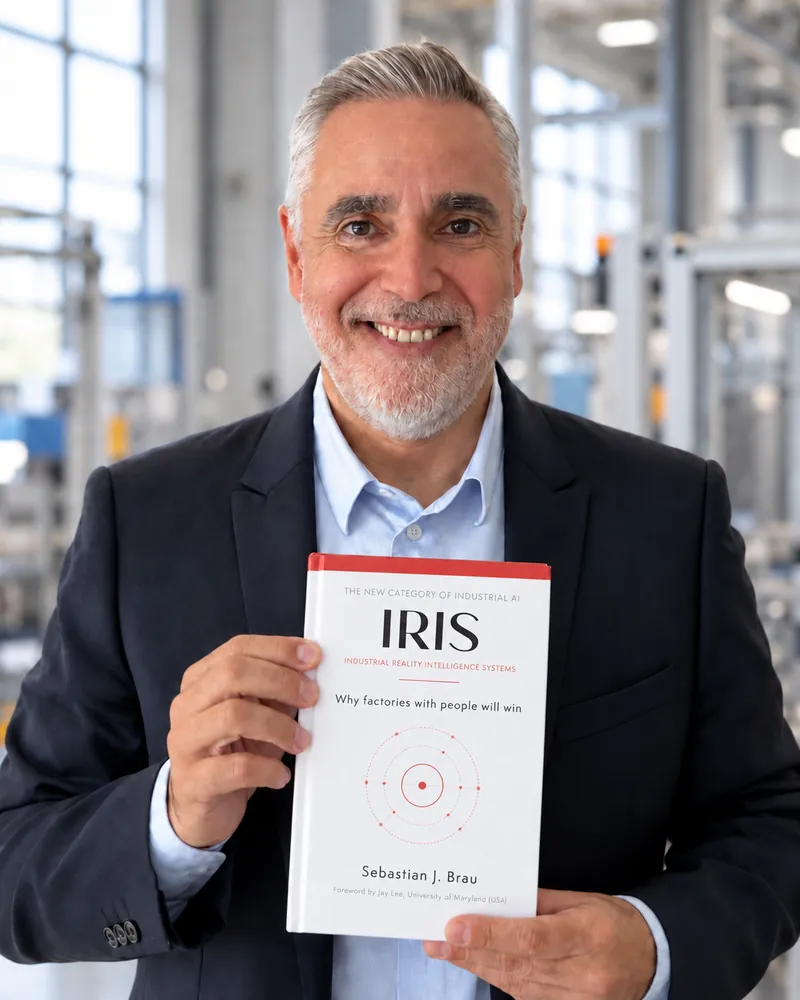
IRIS, Sebastian J. Brau's new book with a foreword by Jay Lee: the two kinds of AI that can enter your factory, and why the ones that empower people will win.
The question every plant asks about industrial AI, and why the factories that win will be the ones that raise the bar for their people.
Jay Lee, Director of the Industrial AI Center at the University of Maryland, has written the foreword to IRIS. Out now in English and Spanish.
Short-cycle AI next to the machine, long-cycle AI above the line. Confusing the two is the most common reason an industrial AI project fails.
The star of the Cevisama fair was heading for the bin over an invisible curvature. An AI in LISP learned from the kiln operators and saved it.
From the first industrial revolution to the fifth, and the lean thinking that holds up everything else. What you need to understand before anyone talks to you about AI.
What an industrial forward deployed engineer is, how it differs from a software FDE, and how FDE teams are built on the shop floor.
What vertical artificial intelligence is, how it differs from generalist AI, and why it is the kind that works on a factory floor.
What the First Industrial Revolution was, when it started and why steam changed the factory forever. Chapter one of the series.
What the Second Industrial Revolution was (1870-1914): electricity, Bessemer steel and the birth of mass production. Chapter two of the series.
How Henry Ford's assembly line (1913) cut Model T assembly from 12 hours to 93 minutes and changed manufacturing forever.
What the Third Industrial Revolution was: transistor, microprocessor, PLC and industrial robots. How electronics automated the factory from 1950 to 2000.
What Industry 4.0 is and how it changes factory work: which jobs disappear, which are born, and why the point is to strengthen the operator.
The five principles of Lean Manufacturing according to Womack and Jones: value, value stream, flow, pull and perfection. Explained for the shop floor.
What 5S is and what the five words mean: sort, set in order, shine, standardize, sustain. The Japanese method explained for the shop floor.
How quality and continuous improvement relate, and why quality stopped being an inspection at the end and became something built during the process.
How to roll out 5S in a plant without it becoming a cleaning campaign: where to start, what to measure and how to sustain it after six months.
What Value Stream Mapping is, what it is for and how to draw one step by step to find the waste in your process.
What the Kanban method is and how to use it outside the factory: a three-column board, a work-in-progress limit and visible tasks. A practical guide.
Which companies apply Lean Manufacturing best — Toyota, Nike, Intel, John Deere, Caterpillar — and the concrete lesson each one leaves behind.
What lean games are and why they work for training teams: they simulate a real line and make waste visible instead of explaining it.
What the Tesla case teaches in lean terms: why forcing production to hit an announced date contradicts the whole Toyota system.
What predictive maintenance is, how it differs from preventive and corrective, and under what conditions it genuinely pays to deploy it.
How lean thinking is applied to agriculture and the food chain to cut food waste from the field all the way to the customer.
What hansei is in Toyota culture: acknowledging the error without hunting for someone to blame, as the step before any continuous improvement that lasts.
What the Kaizen philosophy is and how to bring it into daily life: small, constant improvement instead of big resolutions abandoned in January.
What Lean Government is and how lean principles are applied to public services to cut waiting times and paperwork without cutting the service.
What a kaizen event is and the five mistakes that turn it into wasted time: fuzzy scope, the wrong team and no follow-up.
How to collect data for a Six Sigma project: what to measure, how to avoid the most common biases and why badly taken data is worse than none.
What Six Sigma is, where the name comes from, what the DMAIC cycle involves and what green and black belts mean. Explained without jargon.
What a quality rejection really costs: material and time are the tip of the iceberg. The hidden costs and why they always get underestimated.
How to apply the Kaizen method to personal life: why tiny daily changes beat ambitious resolutions that get abandoned.
The difference between a culture of continuous improvement and Lean Manufacturing, explained through how elite sports teams actually work.
Where Kaizen comes from, the part Deming, Juran and the TWI programme played, and what it takes for it to really take root in a company.
Three Lean Six Sigma tools you can use day to day: the 5 whys, mapping your own time and the PDCA cycle. With simple examples.
Why respect for people is one of the two pillars of Lean Manufacturing and what it means in practice, well beyond being nice to each other.
The 7 wastes of Lean Manufacturing or muda: transport, inventory, motion, waiting, over-processing, overproduction and defects. The TIM WOOD rule.
What a poka-yoke is and how to design one: Shigeo Shingo's method for making the error impossible rather than catching it later. With shop-floor examples.
What SMED or quick changeover is, how internal and external operations are separated, and where to start cutting your setup time.
What genchi genbutsu means, what the gemba is, and why Toyota's «go and see» principle decides whether your improvement works or stays on paper.