
Second Industrial Revolution: the rise of mass production
The point of electricity was never the light. It was getting rid of an iron shaft nobody could see any more. Without that, there's no assembly line.
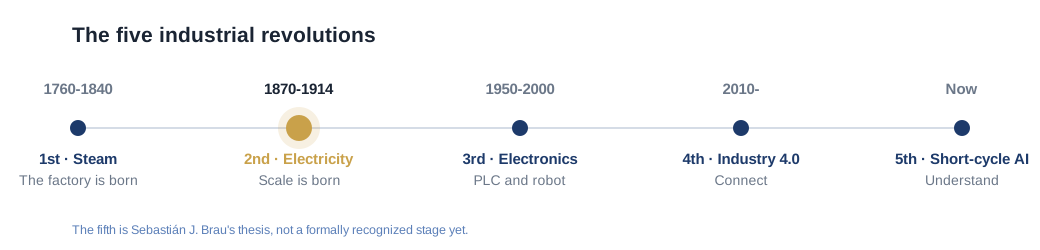
The Second Industrial Revolution runs from 1870 to 1914. Electricity, oil and cheap steel turned the steam factory into a mass-production factory. It started in the United States and spread to Germany, Britain, France, Belgium, Italy, Holland and Japan.
Sebastian J. Brau's blog
Enter your email and you will get an alert when something new is published. Unsubscribe anytime.
The first revolution invented the factory. This one invented scale.
Why electricity changed everything
And this is where you almost always get told the wrong story.
The point of electricity wasn't the lighting. It was that every machine could have its own motor.
Stop and picture it, because it's worth it. In the steam factory there was one huge machine turning a central shaft, and belts hung off that shaft down to every station. What does that mean? That machines weren't placed where the work wanted them. They were placed where the belt reached. The process bent itself around a piece of spinning iron.
Along comes the individual electric motor and that tie is gone. Now you can put the machines in the order the piece is actually made in.
That's where the production line is born. Without electricity there's no assembly line, however much Ford you put on top of it afterwards.
| Innovation | What it unlocked |
|---|---|
| Individual electric motor | machines in process order, not shaft order |
| Bessemer process | cheap steel in quantity: rails, structures, machines |
| Railway and telegraph | markets big enough to justify mass production |
| Oil and combustion engine | your own transport, and the automobile |
Steel — and somebody to buy it
The Bessemer process made steel cheap and plentiful, and that changed what could be built: rails, bridges, structures, machines that held up. The United States supplied the rest: coal, iron, territory, a wave of immigration bringing hands, and a railway that made transport cheap.
But watch this part, because it's the one that gets forgotten. Mass production doesn't appear because you can make a lot. It appears when there's somebody on the other end who can buy it. The railway and the telegraph built that market. Without them, Ford would have been assembling cars for nobody.
The bridge to 2026
From this revolution I take an idea I use in every deployment, and I'm not exaggerating when I say every one:
The technology that wins isn't the one that does the same thing faster. It's the one that removes a constraint you'd assumed was permanent.
Nobody was asking for "one motor per machine". They were asking for more power. What changed the factory was killing the central shaft — a constraint so taken for granted that nobody looked at it any more.
The same thing is happening in your plant right now. The useful question isn't "what task can I automate?". It's another one, and it stings more: what am I treating as impossible just because it's always been that way?
Checking a hundred per cent of the pieces instead of a sample. Knowing where a pallet is in seconds instead of two days. An operator asking the line what's going on and the line answering him.
All three were impossible. None of them is any more. Your central shaft is still there, turning, and you've lived with it so long you've stopped seeing it.