The Fourth Industrial Revolution and the future of work
I'm going to answer the question you actually have in your head. You won't like all of the answer, and it's still the right one.
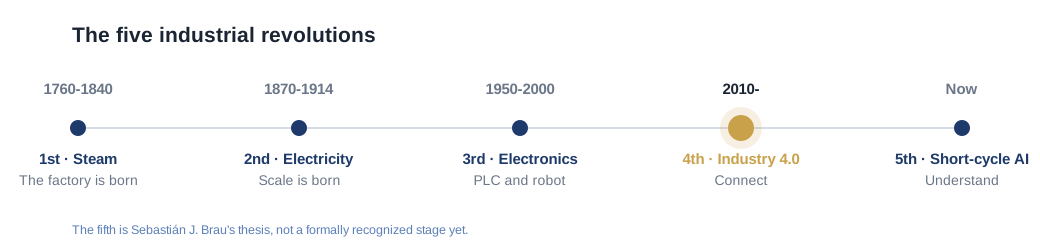
The Fourth Industrial Revolution — Industry 4.0 — is the one that rubs out the line between physical and digital inside your plant: machines connected to each other and to the company's systems, real-time data, decisions backed by artificial intelligence.
Sebastian J. Brau's blog
Enter your email and you will get an alert when something new is published. Unsubscribe anytime.
And its effect on work is less about destroying jobs than about changing what's asked of you in each one.
The real question
Let's take it, because it's the one you've had in your head since you got here and almost nobody answers it without selling you a story:
Is this going to cut my headcount?
We can't be naïve, you and me. At the end of the process, the same work gets done by fewer people. It would be ridiculous otherwise: what would be the point of a brutal transformation effort that left your productivity exactly where it started. If you do it right, one person will handle what used to need two. That's how it is and I'm not going to hide it from you.
But that isn't the important question. The important one is: what do you do with that gain?
Because from there two roads open up, and they're nothing alike even though both start out equally well. One uses it to do more with the same people and take a bigger bite of the market. The other uses it to run the same factory with fewer people. The first grows. The second fades out slowly, and never quite works out why.
What changes in the job
Every previous revolution brought social change that some saw coming and others didn't. This one has a particularity: it doesn't replace muscle. It replaces pieces of judgement.
What I see on the floor is a fairly clean shift:
| Task | Where it's going |
|---|---|
| Writing data on paper by hand | the system captures it |
| Inspecting by sampling | 100 % verification in line |
| Hunting the cause of a fault after the shift | alert the moment it happens |
| Executing a memorized procedure | the system guides, the operator decides |
| Filling in audit reports | the evidence pack builds itself |
And what stays on the human side isn't the easy part. It's the hard part: deciding with judgement when the system isn't sure, and standing behind that decision. That job asks for more training, not less. Anyone who tells you AI "simplifies" the operator's work has never stood a night shift.
The bridge to 2026: the fifth revolution
Twenty-five years putting AI into factories makes me think we're already in the next chapter, even if it hasn't got a name we all agree on yet.
Industry 4.0 was about connecting. Sensors, networks, data, beautiful dashboards. Plenty of plants did that whole job and ended up with masses of data and exactly the same decisions as before. I've sat in those meetings.
What I call the fifth revolution is those systems also understanding what they're looking at, and acting inside the cycle of the process. In seconds. Not in next month's report, when the pallet is already on its way to the customer.
I call it short-cycle AI: trained in weeks, acting inside the process, learning from its own daily work. It doesn't replace your operator. It takes the paperwork off him and warns him before the problem walks out the door.