Third Industrial Revolution: the Digital Revolution
The factory wasn't digitized by the computers in the offices. It was digitized by two machines almost nobody names. I spent four years programming one of them.
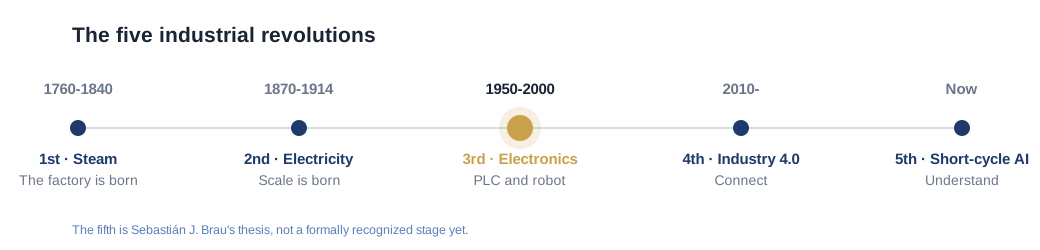
The Third Industrial Revolution — the Digital Revolution — is the jump from analogue to digital, from the late fifties to the end of the twentieth century. Underneath it are the transistor (1947) and the microprocessor (1971). But inside your plant it came down to two machines: the PLC and the industrial robot.
Sebastian J. Brau's blog
Enter your email and you will get an alert when something new is published. Unsubscribe anytime.
This is the revolution that automated production. Now, look closely at what it automated. That's where the whole difference with what comes next is hiding.
From the transistor to the shop floor
The transistor planted the seed: electronics that were small, cheap and reliable. The microprocessor brought computers, telecoms and eventually the internet.
But in industry that turned into something very concrete and not at all glamorous.
Before the PLC, changing a machine's logic meant rewiring a cabinet full of relays. By hand. With the PLC you just reprogrammed it. And the industrial robot took over what was repetitive, heavy and dangerous, with a precision no operator can hold for eight straight hours — because we're people, not spindles.
| Invention | Decade | What it solved in the factory |
|---|---|---|
| Transistor | 1947 | small, cheap, reliable electronics |
| PLC | 1968 | change the logic without rewiring |
| Industrial robot | 1961-70 | precise, constant repetition |
| Microprocessor | 1971 | control and computing inside the equipment |
| Networks and internet | 1990s | connect machines, plants and companies |
The catch?
That this kind of automation is deterministic. The machine executes perfectly what somebody wrote beforehand. Perfect, as long as conditions hold still.
What it cannot do is face something nobody foresaw. A defect that isn't on the list. Raw material that arrives different today. A situation that calls for judgement. All of that stayed human. And it stayed your bottleneck.
The bridge to 2026
This is where my own story starts, so let me tell it.
Late nineties, me in my early twenties, at Keraben, a ceramics group in Castellón. For four years I developed, almost single-handed, the industrial software systems for six or seven factories. I had my hands in glaze milling with its chemistry, in the presses with their mould inventory, in the kilns with their thermocouples and temperature curves, in sorting with its shade and calibre.
So: I'm a child of this revolution. I programmed it.
Which is exactly why I know where its ceiling is. The PLC executes rules written in advance. An industrial AI system learns from what it watches go down the line and recognizes what nobody ever typed out. At a bakery we work with, the AI doesn't run through a list of defects: it looks at every piece five times a second and warns you that two of them are too close together and will stick in the oven.
That doesn't fit in a PLC. And it isn't a question of processing power. It's that nobody knew it needed programming.
Industry 4.0 connected your machines. What's coming now is that they also understand what's happening inside them.