Santo Domingo, HUMANOS 5.0: 400 leaders, a manifesto and a question I brought home
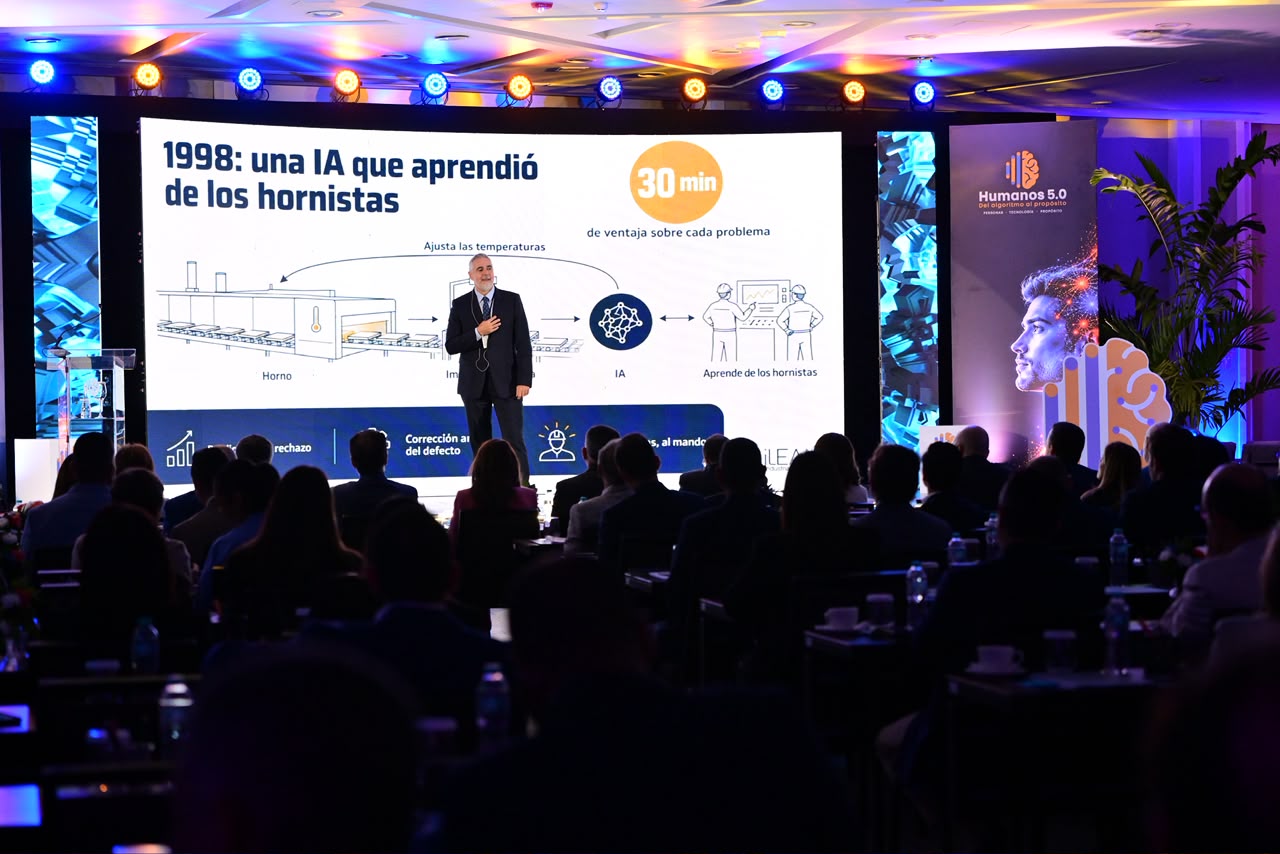
On 29 October I opened day two of the HUMANOS 5.0 International Summit in Santo Domingo. More than 400 leaders from Dominican business, government and academia. Two days. One question: what role is left for people when artificial intelligence is already everywhere?
Sebastian J. Brau's blog
Enter your email and you will get an alert when something new is published. Unsubscribe anytime.
I arrived with a story from 1998. I came home with a new question.
What I told them: the kiln operators of 1998
I told them about Keraben. A star product going into the skip because of a curvature nobody could see. An AI that watched the kiln operators work, learned from them, and ended up arriving thirty minutes ahead of the defect. People in charge. The full story is here.
Why tell it in Santo Domingo, almost thirty years later? Because the question in that room was the same one that factory was asking. It's not whether AI will come in. It's who's in charge when it does.
My answer hasn't changed. Almost thirty years on, the idea is still fixed in my mind: the best AI isn't the one that thinks for you. It's the one that brings out the extraordinary in the people who use it.
A book for every attendee
There was a gesture I won't forget. Manuel Corripio printed more than 400 copies of IRIS, my new book, in an edition for the Dominican Republic. Every attendee took one home at the end of the day. Free of charge.
The book's core idea fits in one sentence: nobody should choose to replace people because they think there's no other option. Getting that sentence into the hands of 400 people who make decisions in companies and institutions, all at once, is worth more than any campaign. Thank you, Manuel.
A country that puts it in writing
The summit was organised by Zoraima Cuello and the AIITEC team. And it closed with something you don't see often: the signing of the first Dominican Manifesto for People-Centred Artificial Intelligence. In the room were the Minister of Education, the country's leading companies, the universities and international organisations.
The HUMANOS 5.0 Index, presented right there, shows where things stand. 70% of the leaders surveyed use AI every day. 66% admit their teams use it with no policy governing it. AI is already inside. What's missing is deciding the rules. That's exactly what the manifesto puts on the table.
Thank you, Zoraima, for the invitation and for a first-class summit.
The ones already doing it
And thank you to those who don't wait for manifestos. To Pedro Brache and the Brache family, for their trust in Grupo Rica's AI project. To José Ramón Peralta and his sons, Raúl and José, for trusting us to deploy AI at Constanza and Abodom. And to the many clients and friends across the region who already work with our industrial AI systems.
I named them on stage and I name them here. They're the proof that this never stays in the brochure.
The question I brought home
I brought a question back from Santo Domingo that I haven't been able to shake. If AI can make sure a factory doesn't get it wrong, can it make sure a public administration can't be bent?
Ideas, always from people. Execution, with no shortcuts. I'll tell you about it in the next piece.