
Ford's assembly line and mass production
Ford invented none of the parts he used. He put together things that already existed and pushed them to the limit. That's the lesson — and also the mistake I still see.
On 1 December 1913, at Highland Park, Henry Ford moved the line. And the world changed places.
Sebastian J. Brau's blog
Enter your email and you will get an alert when something new is published. Unsubscribe anytime.
A Model T used to take twelve hours to assemble. After that, 93 minutes. That isn't an improvement — it's a different thing altogether. The car dropped in price until the man building it could afford one, and that's where mass production really begins. Everything before was theory.
The idea didn't come from cars
Ford invented not one single piece of the puzzle. Interchangeable parts came from the gun trade. The moving line came from the Chicago slaughterhouses, where the carcass travelled along a rail and each man made one cut and one only.
What Ford did was put them together. And push them to the limit.
The principle looks stupid, it's so simple: instead of the operator going to the work, the work goes to the operator. Think about it in your own shop. Count what your people walk, search and wait for in one shift. In a 1910 workshop that was most of the day. Ford killed it in one move.
| Traditional workshop | Ford's line (1913) | |
|---|---|---|
| Movement | the operator goes to the piece | the piece goes to the operator |
| Task | builds the whole car | performs one step |
| Assembly time | ~12 hours | 93 minutes |
| Pace | set by the operator | set by the line |
| Variety | whatever's ordered | "any colour, so long as it's black" |
The catch?
That somebody paid for the productivity.
Ford built his first Quadricycle in 1896, founded the company in 1903 and launched the Model T five years later. To make it cheap he kept stripping options until all that was left was "any colour, so long as it's black". Variety is expensive. He decided price mattered more.
But the work got so repetitive that people walked straight out the door. Turnover went through the roof and Ford had to double wages to five dollars a day just to keep anyone inside. That bill is as much a part of the story as the 93 minutes, and almost nobody mentions it when they show you the chart.
The bridge to 2026
For me this is the most important piece in the series. Because inside it sits the mistake I'm still watching a hundred years later, in real plants, with real people.
Ford optimized flow brilliantly. And he did it by fixing variety at zero. It worked as long as the market swallowed a single product. The day General Motors offered models and colours, that same rigidity stopped being his advantage and became the stone round his neck.
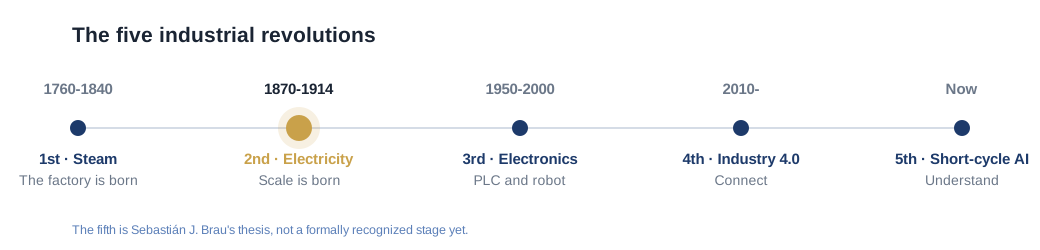
Today the constraint runs the other way. Your customer wants short runs, part numbers that change, and to know where every single unit is. The rigid line is no use to you. That's why I've spent years talking about short-cycle AI: systems trained in weeks rather than quarters, that re-adapt when the product changes — because it's going to change.
I saw this before I could name it, in a factory that ran in the dark with nobody inside. It was impeccable. And it was built on an assumption nobody had gone back to check.
The lesson of Highland Park isn't "optimize the flow". It's that every optimization assumes a context. You had better know which one you've assumed, before you set it in concrete.
And you don't check it from a desk: you check it by going down to the line. That is what industrial forward deployed engineering is about.